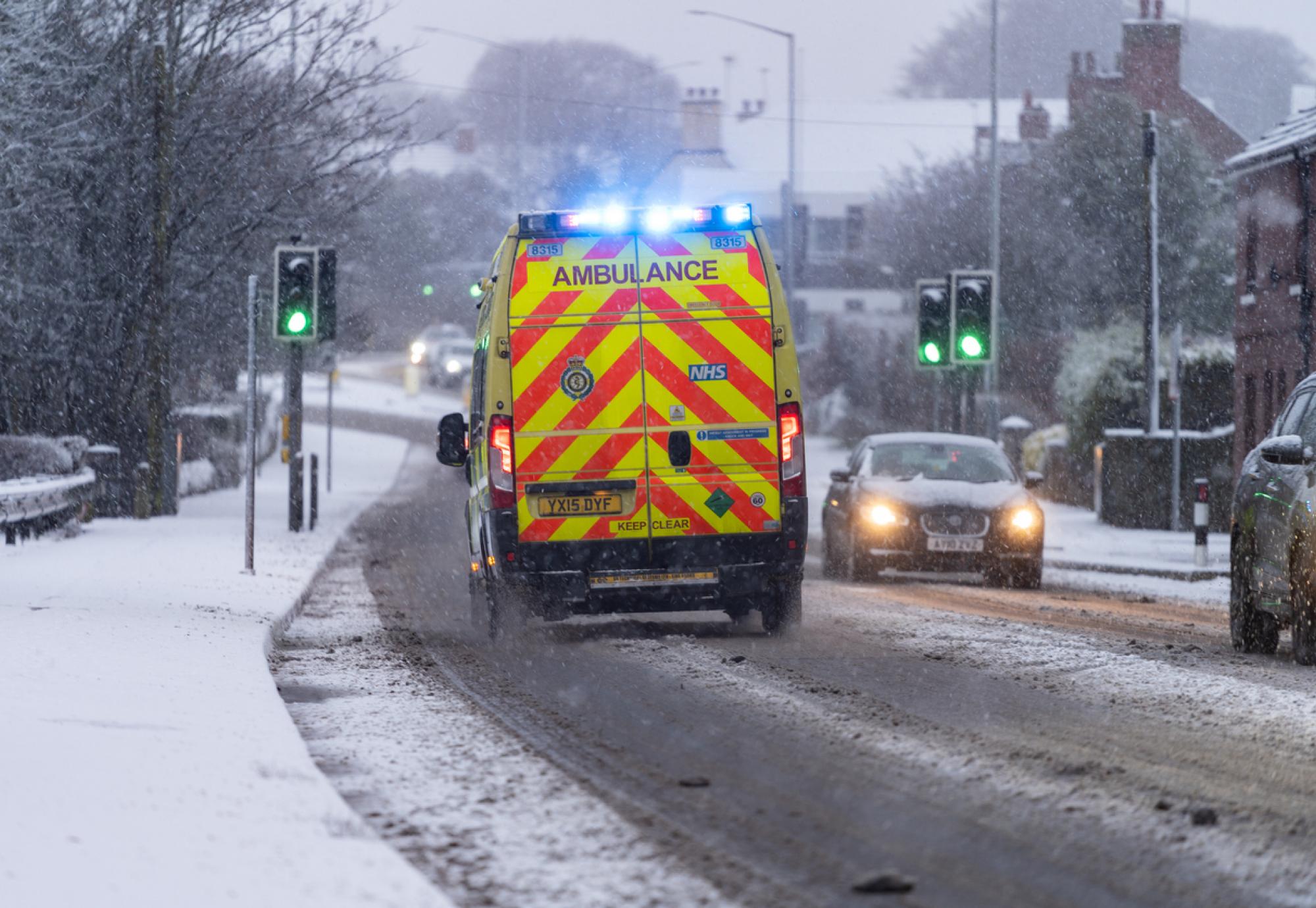
Draft winter plans are due this month. Board assurance statements are due 30 September. Here's a practical checklist for the part of the plan that usually gets written last — and matters most in January.
Winter Planning 2026/27: The Capacity Question Most Plans Answer Too Late
Draft winter plans are due this month. Board assurance statements are due 30 September. Here's a practical checklist for the part of the plan that usually gets written last — and matters most in January.
Every winter plan contains a demand and capacity model. Very few contain a credible answer to the question that model raises: and if the surge scenario actually happens, where does the extra capacity physically come from?
That is not a criticism of the people writing the plans. It is a scheduling problem. By the time a system knows it needs additional crews, vehicles or transfer capability, it is usually December, everyone else needs the same thing, and the market has nothing left to sell.
With draft plans due to local partners by the end of August and board assurance statements due to NHS England by 30 September 2026, this is the window where that gets fixed. What follows is a practical guide — for ICB winter leads, trust operations teams, and the care providers and hospices who sit downstream of both.
What last winter actually told us
Winter 2025/26 was, on the headline numbers, a better winter than the one before it. It was also a busier one.
By late February, NHS England had handled 1,234,731 ambulance handovers so far that winter — almost 52,000 more patients than the equivalent period the year before, and the highest volume since 2021/22. Despite that, handover times improved: that week's average had fallen to 28 minutes 14 seconds, more than seven minutes faster than the same week a year earlier (35:36), with handovers over 30 minutes down 21.9%.
That is a real improvement, and the crews and flow teams who delivered it deserve the credit. But two things are worth sitting with.
First, the peak is still brutal. In the week ending 29 January 2026, the NHS recorded 94,551 ambulance handovers — busier than the busiest week of the previous winter — with average handover times back up at 34 minutes 32 seconds. Norovirus alone was taking over 1,100 adult beds a day out of the system, with an average of 950 patients in hospital with the virus daily. Flu was running at an average of 1,987 patients a day, COVID at 647.
Second, the annual average hides the winter shape. Nuffield Trust analysis shows roughly 23% of handovers exceeded 30 minutes in March 2026, and around 5% exceeded 60. Rewind to the December 2024 peak and those figures were 37% and 17%. Performance does not degrade gently in winter. It falls off a cliff for about six weeks and then recovers.
Plans built on annual averages will be wrong in exactly the weeks they need to be right.
What's expected of you this year
NHS England's winter planning expectations for 2026/27 are more prescriptive than in previous years. The headlines:
- A named executive winter lead at every ICB and every trust, personally accountable for preparedness.
- Whole-area demand and capacity analysis, with surge and extreme surge scenarios tested — not just modelled.
- Regional stress test exercises through September, before board sign-off.
- Seven-day coordination centres operating against the OPEL framework.
- Ambulance handovers within 15 minutes, with none exceeding the 45-minute maximum — building on the "Release to Rescue" standard introduced in the 2025/26 UEC plan, which triggers at 30 minutes to get crews off site by 45.
- Category 2 response times delivered against the 2026/27 trajectory, while maximising hear-and-treat, see-and-treat and referral alternatives to ED.
- Corridor care eliminated as a patient safety priority.
Note what those last three have in common. Every one of them is a flow target. You cannot hit a 45-minute maximum handover by asking crews to work faster. You hit it by ensuring there is somewhere for the patient to go, and something to move them in.
The eight-point capacity checklist
Work through these before your board assurance statement is signed, not after.
1. Model the six worst weeks, not the season. Take your December–February profile and isolate the peak fortnight. That is your real capacity requirement. If your plan is sized for the winter average, it is sized for a winter you will not have.
2. Separate your conveyance demand by type. Emergency response, urgent inter-facility transfer, timed discharge transport, bariatric, mental health conveyance, and repatriation are six different capability requirements with six different vehicle and crew profiles. A single "additional ambulance capacity" line in a plan is not a plan.
3. Quantify your discharge transport gap specifically. Delayed discharge is the single biggest lever on bed occupancy, and transport is a recurring reason discharges slip past the point where a same-day discharge becomes a next-day one. Ask your flow team how many discharges last January were delayed by transport availability. If nobody has the number, that is your first action.
4. Contract capacity before you need it, on a standby basis. The commercial structure matters more than the headline rate. A retained standby arrangement — agreed crews and vehicles, held against your peak weeks, at an agreed rate — costs a fraction of spot-purchasing in January and is the only version that is actually available in January.
5. Test the escalation route, don't just document it. Who picks up the phone at 22:00 on 27 December? What is the guaranteed response window from request to vehicle on site? Put it in the contract as a number, and then run it as part of your September stress test.
6. Bring your care providers, hospices and community teams into the same conversation. Winter pressure is a whole-system phenomenon and step-down capacity is worth nothing if nothing can move a patient into it. Care home managers reading this: your escalation and transfer arrangements should be written down and agreed before November, and your provider should be able to tell you what happens when you call at 3am.
7. Check the infection control plan covers the transport link. Norovirus took 1,100 beds a day out of the system last winter. Vehicle deep-clean turnaround, crew isolation policy and IPC training are part of your surge capacity, because a vehicle out of service for decontamination is a vehicle you do not have.
8. Agree the data flow now. If additional capacity is not visible on your coordination centre's operational picture, it will be under-used at exactly the moment it matters. Agree what your provider reports, how often, and into which system, in September.
Due diligence: what to ask any independent provider
Not all independent capacity is equal, and procurement under time pressure is where standards slip. Before you sign anything, ask for:
- CQC registration for the specific regulated activities you need, plus the most recent inspection report and rating.
- Clinical governance structure — named clinical lead, incident reporting and investigation process, and how learning is fed back to crews.
- Staffing evidence — registration status of clinicians, enhanced DBS checks, safeguarding training levels, and whether crews are employed or sub-contracted (and if sub-contracted, who governs them).
- Insurance and indemnity at levels appropriate to the activity.
- Fleet detail — vehicle specification, service records, equipment inventory, and IPC/decontamination protocol.
- Demonstrated surge performance — not a promise, but evidence of what they actually delivered during a previous peak, with references.
- Information governance — DSPT compliance and a DPIA where patient data flows between organisations.
A good provider will have all of this ready and will not be offended that you asked. A provider who is slow to produce it in September will be slow when you need a vehicle in January.
The honest version
Independent capacity is not a fix for a system under structural strain, and any provider who tells you otherwise is selling something. Winter pressure is driven by bed occupancy, social care availability, workforce and demographics, and none of those are solved by a contract.
What contracted capacity does is narrower and still worth having: it protects flow at the margins during the specific weeks when the margins are where everything is decided. It gets a discharged patient home the same day. It keeps an emergency crew from spending four hours on a transfer. It means a care home escalation does not default to a 999 call.
That is a real contribution, and it is only available to systems that arranged it in September.
Talk to us before the September deadline
Spark Medical works with NHS trusts, ICBs, care providers and hospices to build contracted surge capacity into winter plans — emergency response, urgent transfer, and discharge transport, with retained standby arrangements sized around your peak weeks.
If you are finalising a winter plan and the capacity section is the one still open, we would rather have that conversation now than in December.
Sources
- NHS England, Patients handed over quicker despite 5-year high in number taken to hospital, 26 February 2026
- NHS England, NHS services tackling winter head on, January 2026
- NHS England, Winter planning 2026/27 – expectations and assurance
- NHS England, Urgent and emergency care plan 2025/26
- Nuffield Trust, Ambulance handover delays, data to March 2026